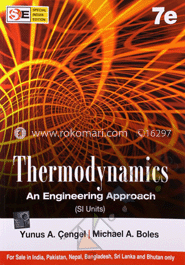
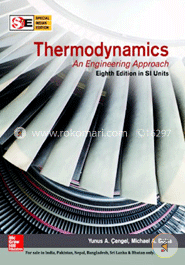
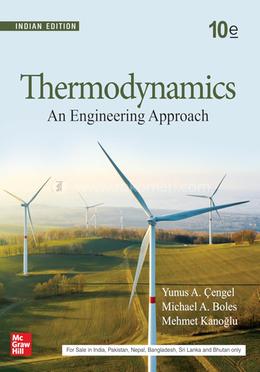
This book, Thermodynamics, is intended to be used as a textbook by undergraduate engineering students and as a reference book for practicing engineers.
It is known to be student-friendly, self-instructive, and easy to read, even for the most challenging topics, with the help of attractive illustrations, examples, and real-world applications.
The book approaches the subject with a learning by practicing philosophy. A special effort is made throughout to reinforce earlier material and to appeal to students’ natural curiosity and intuition.
✨ Salient Features
Covers basic principles of thermodynamics such as pressure, forms of energy, and laws of thermodynamics.
Presents a wealth of real-world engineering examples enabling application-based learning.
Helps develop an intuitive understanding of thermodynamics by emphasizing the physics and physical arguments that underpin the theory.
🌐 Web Supplements
Instructor Resources
Available online via McGraw-Hill Connect, including:
PowerPoint Presentations
Image PowerPoints
Instructor Solutions Manual
Appendices
Conversion Factors PDF
Glossary
Power and Refrigeration Cycle Interactives
Ammonia Tables
Video Trans
Student Resources
3D Animated Videos
Worked Example Videos
📑 Table of Contents
Introduction and Basic Concepts
Energy, Energy Transfer, and General Energy Analysis
Properties of Pure Substances
Energy Analysis of Closed Systems
Mass and Energy Analysis of Control Volumes
The Second Law of Thermodynamics
Entropy
Entropy Analysis
Exergy
Gas Power Cycles
Vapor and Combined Power Cycles
Refrigeration Cycles
Thermodynamic Property Relations
Gas Mixtures
Gas-Vapor Mixtures and Air-Conditioning
Chemical Reactions
Chemical and Phase Equilibrium
Compressible Flow
 Hotline: 16297 (9.00 AM to 11.00 PM)


 Hello, Sign in
 Cart
Cart 

.svg)