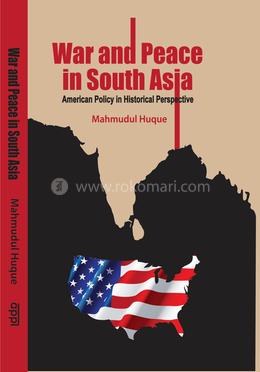
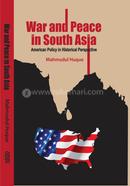
This book is about American policy in the South Asian subcontinent focused on the issues of war and peace in the region. U.S. involvement in the region was dictated by the imperatives of the Cold War, and its main goal was to enhance its perceived interests by preventing the spread of Communist influence. For this amicable relations among the regional countries were necessary, but such a situation was precluded by the perennial hostility between India and Pakistan. Washington played a significant role in the regional conflicts.
However, U.S. efforts to influence regional affairs in accordance with its own wishes met with only limited success. For one thing, Washington’s Cold War considerations were mostly irrelevant to the regional actors. The end of the Cold War necessitated different set of priorities for the United States in its South Asia policy, of which nuclear nonproliferation and war on terror figured prominently. But the incongruence between American goals and those of the regional countries frustrated Washington’s policymakers. In the recent years, American stakes in the region took on a new urgency because of the possession nuclear weapons by both India and Pakistan. Any future conflict between them might prove infinitely more dangerous—with critical implications for perceived American interests and security.
Mahmudul Huque is Professor of History, University of Chittagong, Bangladesh, with specialization in South Asian history, foreign policy, security, and US interests in the region. His numerous awards include a Ford Foundation fellowship at the Center for International and Security Studies, Maryland (CISSM), a Korea Foundation Field Research Fellowship and a Senior Fulbright Fellowship. Dr. Huque's most recent publications are War and Peace in South Asia: American Policy in Historical Perspective (Dhaka: Academic Press and Publishers Library) and From Autonomy to Independence: The United States, Pakistan and the Emergence of Bangladesh (New Delhi: Vikas Publishing House Pvt. Limited).