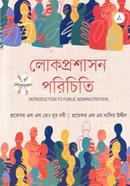
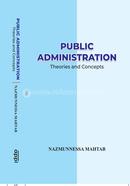
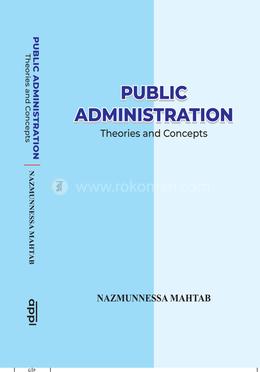
The title of the book as “Public Administration: Theories and Concepts” demands some explanation. The book is the product of culmination of my four decades of study in this particular area. Question may arise in any one’s mind.-why such a delay in constructing the book. To be honest, I have been teaching the core course entitled PA 201: Introduction to Public Administration. From the time, I joined the Department of Public Administration as a lecturer; I was entrusted with teaching this course. Well to me, although as the name spelled out, it meant an introductory course to be aligned with the subject matter. However, for me it was totally a different picture. My thoughts were that, though introductory, it did include all the various aspects and dimensions of the discipline. For example, starting with the meaning of ‘public,’ as it covered the wide range of the subject matter beginning from what does government do for the public. So what is administration? Simply put, public to administer means to carry out a task. Increasingly, however, to administer means something much more complex, including looking after the interests, accounting for consequences and also justifying actions. From these few words, I found that the matter is not quite an easy one. Public administration did cover a variety of issues, which through out my very long time of teaching I managed to cover a wide spectrum of dimensions I did feel the need of incorporating all the ideas, topics, issues, theories, concepts into a complete book so that students pursuing the introductory course become fully versed with understanding the core issues and problems of public administration. Now let us see where we start from. Public administration is the concern of all those who on behalf of the public, on behalf of the society, carry out actions and have consequences for the members of the society, singly or as a group. Together with this, we try to focus on people working as groups both in formal and informal sphere and see how the informal relations become prominent and influential in determining the working of the organization, in communication, decision-making and exercising leadership. All these take us to the very scope or environment of public administration, which are embedded in different theories and concerns of the discipline. My aim of the book has been to try to relate theories of the administrative process to the actual functioning of the government system. Much of the book deals with the relationship between the concepts of organization and behaviour of individuals. My starting point is the belief that there is little relation of theories to practice in the study of public administration. There is a large descriptive literature dealing with theories of organization and bureaucracy. The book has three parts. First part deals with the meaning and different definitions of public administration focusing on the content and context of the subject. The second section deals with the different concepts of public administration and how these are related to real life situations of the people both in the government and in private sector. How people are motivated, how decisions and policies affect the lives, and how leadership functions to influence and control the lives. The last part concentrates on a very short account of the administrative system of Bangladesh and describes the multiple problems faced by the country and how the role and relationships between the politicians and bureaucracy are addressing this in achieving the goals of sustainable development in the country. The book will be relevant for those studying public administration, political science, management, business administration, organizational behaviour, leadership studies and other courses on social sciences.
Dr. Nazmunnessa Mahtab is Honorary Professor in the Department of Women and Gender Studies, University of Dhaka. She is also one of the founding members involved in the establishment of the Department in 2000. She had been a teacher in the Department of Public Administration, University of Dhaka from 1972 to 2003. Dr. Mahtab served as the Chairperson of the Department of Public Administration from 1986-1989 and Chairperson of the Department of Women and Gender Studies from 2003-2006. She had participated in national and international seminars and conferences both at home and abroad and has written extensively on women’s issues and problems. Dr. Mahtab has been actively involved in her teaching profession. She has been working as an Adjunct Faculty at North South University (The first Private University in Bangladesh) since 2002 and at Independent University (IUB) since 2014. She has been working on women’s issues and concerns for more than four decades, and has conducted many researches works on diverse aspects of women’s lives. Her areas of specialization and interests include: Women and Poverty, Gender and Development; Women and Education, Women in Politics, Violence Against Women; CEDAW and Women’s Rights; Gender and Governance, Women in Public Policy and Leadership and Empowerment of Women. She is associated with many women’s organizations, both at home and abroad. Dr. Mahtab possess the experience and expertise of working as a Gender Consultant with the Government as well as with many international agencies, such as, the UNDP, UNFPA, UNICEF, ILO, WHO, USAID. She has worked with many NGOs assisting them in developing a Gender Policy for their respective organizations. Dr. Mahtab also participated in gender training programs first as a trainee and later on as a trainer. She had participated in national and international seminars and conferences both at home and abroad and has written extensively on women’s issues and problems. She has published three books: 1) Women in Bangladesh: From Inequality to Empowerment (2007); 2) Introduction to Women and Gender Studies: Selected Texts on Issues and Concepts, (2011); 3) Women, Gender and Development: Contemporary Issues (2012, & 2015). Her recent publications include: 1) “Women’s Transformational Leadership in Bangladesh: Potentials and Challenges,” published in Women, Political Struggles and Gender Equality in South Asia edited by Margaret Alston, Palgrave Macmillan, August 2014; 2) A co-edited book entitled: “Digital Public Administration And E-Government in Developing Nations,” published by IGI Global Publishers, USA, in August, 2014. She (co-edited): 1) Discourse Analysis as a Tool for Understanding Gender Identity, Representation and Equality, and 2) Revealing Gender Perceptions and Inequalities in the South Asian Countries through Discourse Analysis published by IGI, Global, USA, June, 2016; 3) Women’s Issues and Rights in the Developing World, published by IGI Global Publishers, September, 2017.
 Hotline: 16297 (9.00 AM to 11.00 PM)


 Hello, Sign in
 Cart
Cart 




.svg)