9 verified Rokomari customers added this product in their favourite lists
TK. 250TK. 199 You Save TK. 51 (20%)
Related Products
Product Specification & Summary
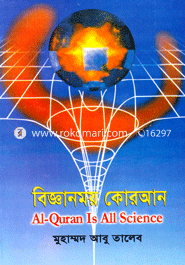
'Science' is an English word, which was originally coined by the Christian Priests to mean the sign of God (ayatullah). It was used as such from 1340 onwards by the priests and poets as "science of God". Shakespeare used it to mean the mystery of Nature, i.e. the mystery of creation.
However, what is now called 'experimental science used to be called 'natural philosophy' till 1830. Scientiis or Scientiae experimentalis, though exactly meant experimental science, were avoided by the Europian scholars in view of the hostility of the Catlolic Christian priests towards those terminologies.
Nevertheless, by the middle of the 19th century C.E. the Greek oriented 'natural philosophy' was replaced by 'experimental science'. Hence, experimental science, by implication means al-ulum at-tajribiyah and scientiae experimentalis.
The original Arabic word ulum is plural of ilm which means sciences. The Qur'an for the first time grounded the wider meaning of Ilm-learning. The Prophet accorded to it a permanent shape and the term gradually acquired that of the exact meaning of 'Science' in the hands of the early Muslim scholars.
For instance, Jabir Ibn Hayyan, the father of the experimental sicence of chemistry or Alchemy, set Tajribh as the core plank of scientific methodology. Later on, Al-Khwarizmi (9th century C.E.) invented algebra cum arithmetic and Al-Kindi (9th century C.E.) further developed and extended it to the fields of medicine, astronomy and physics.
Finally, Al-Farabi, Ibn Miskawaih, Ibn Sina, Ibn Haytham and Al-Biruni raised al-ulum at-tajribiyah to the golden height (even before the Western scholars began translating their works into Latin (mid-12th century C.E.).
Science was, thus, neither inspired by the Greeks nor by the Romans nor even by the Hellenic cultural tradition, but was a gift of the holy Quran, the Prophet of Islam and the early Muslim scholars.